The Crybaby Councilor Strikes Again: Flynn proposes limits to early voting in response to isolated poll incident
Three voters got the wrong ballots in South Boston. Ed Flynn's answer is to limit early voting for the other 440,000.
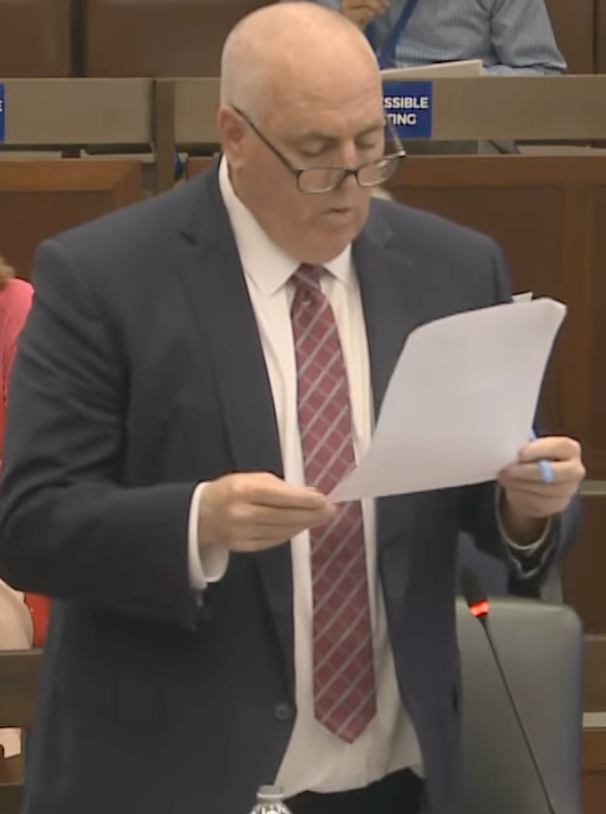
Three people at the Condon Community Center in South Boston were handed the wrong ballots during early voting last week. Poll workers caught it. All three got the right ballots. Everyone went home.
On Wednesday, Councilor Ed Flynn asked the Boston City Council to use those three ballots to shrink early voting options for all 440,000 registered voters in the city.
His resolution, first reported by Universal Hub, asked the Secretary of the Commonwealth to open a formal investigation into the Boston Election Department and to keep the department under state receivership through the 2028 presidential election. It also asked that early voting sites stop carrying ballots for the whole city.
"I believe the city should only offer in person early voting in one's own neighborhood and district or at City Hall," Flynn told his colleagues. He went on to claim, without evidence, "When we allow residents to vote at every location throughout the entire city, I think it puts a tremendous strain on the system. I think it's also unfair to our poll workers that have to have a ballot ready regardless of where the person is coming in from. We only increase the chances of incidents where human error can occur when a poll worker provides the wrong ballot."
Then he called it a civil rights issue.
Using Civil Rights to End Civil Rights
Vote-anywhere early voting is not a recent experiment. It is the oldest feature of early voting in Boston, and it arrived with a specific promise attached.
Governor Deval Patrick, the first Black governor of Massachusetts, signed the 2014 election reform law that created early voting. Boston's first early voting period opened October 24, 2016. Two weeks before it did, then-Mayor Marty Walsh penned an op-ed in the Bay State Banner describing what made it worth doing:
"One of the reasons this initiative is innovative is that voters participating during the early voting period will be able to cast their ballot at any polling location in the City, regardless of what neighborhood they live in. We hope that this additional flexibility will allow more people to take part."
Walsh put $670,000 in that year's budget behind it, including the electronic poll books the city still uses to check voters in. The city has advertised the same promise every cycle since. A 2018 Election Department ad in the Banner read: "Registered Boston voters can vote at any early voting location in the City, including City Hall. Pick a time and place that is best for you."
The coalition that won the 2014 law made the equity argument explicitly. Common Cause Massachusetts pointed to evidence that early voting and extended hours help people of color and lower income voters most, because their schedules are the least predictable. The point of letting a Roxbury resident vote in Chinatown on her lunch break was never administrative tidiness. It was that she works in Chinatown.
The statute itself carries that instruction forward. Under Chapter 54, Section 25B, when a city designates early voting sites it "shall consider, to the extent feasible, diverse geographic locations and whether such sites would have an impact on access to the polls on the basis of race, national origin, disability, income or age." The law contains no provision letting a city tell a registered voter which early voting site is hers.
Flynn is invoking civil rights to undo a program whose governing statute has a civil rights clause built into it.
Armed With Accusations But Not Evidence
Flynn offered no evidence to back up his claims. There is a reason.
No Boston poll worker has publicly complained about carrying multiple ballot styles in testimony, in the press, or online. The only workload complaints in Massachusetts come from small-town clerks, and they are about something else entirely: the number of days. The president of the state Town Clerks Association told State House News Service this month that early voting is "a mini election every day" and that the answer is fewer days, not fewer ballots. Nobody in the Commonwealth has proposed what Flynn proposed.
There is no measured increase in wrong-ballot errors since 2016. Boston has spent a decade engineering against exactly that failure. Every early voting site in the city uses electronic poll books that pull the voter's record and identify the correct ballot on check-in. The Condon incident was a human overriding a machine built to prevent it, which is a training problem with a training fix.
And the load he describes is shrinking, not growing. Statewide, early in-person voting was 30.7 percent of ballots in 2016 and 21.2 percent in 2018. By the 2024 state election it was 17 percent, and in the 2024 primary, 3.4 percent. Galvin's office puts it plainly: early voting has dropped significantly since people started voting by mail.
Flynn's claim requires early voting to be simultaneously so heavy it strains the system and so marginal that restricting it costs nobody anything. Both cannot be true.
Boston turnout, meanwhile, is the actual crisis nobody filed a resolution about. Last November's municipal election drew 96,405 ballots, a 22.39 percent turnout, down from 32.66 percent in 2021 and 27.80 percent in 2017. Presidential years run roughly three times higher. The city is not struggling with too many people voting. Councilor Ruthzee Louijeune, opposing the resolution, said the city should be moving the other way, toward same-day registration and wider access, "especially as the right to vote is under attack."
A Solution in Search of a Problem
Here is what makes the proposal perplexing rather than merely wrong.
Boston's Election Department is in receivership because it did not send enough ballots to polling places. In November 2024, officials chose to send only enough ballots for 80 percent of each precinct's registered voters who had not yet voted, and a calculation error made the actual delivery smaller still. Police cars ran ballots to precincts with sirens on. The department did not answer more than a thousand calls from poll workers and residents trying to report it. The state's investigator found Boston in violation of the election law requiring one ballot to be available for every voter, and concluded that some voters were disenfranchised because they could not wait.
Flynn's remedy for three mis-delivered ballots is to deliberately withhold ballots from polling locations. He is proposing, as a cure, the precise category of conduct that put the department in receivership.
He also wants the receivership extended through 2028. It is currently set to run through the end of this year, when Galvin's office will reassess based partly on how this election goes. Flynn is asking to prejudge that review before the election has happened. Boston reported no major problems last fall.
Crying Wolf
Two weeks ago, after two stabbings, Flynn called for the National Guard to be deployed in Boston. He filed no hearing order and named no cost. A New England Ledger analysis found that an occupation would cost taxpayers up to $110 million annually. The mayor called the idea foolish and irresponsible. Within a day he had backed off.
He is rarely making the case alone, as we detailed in our RIGGED reporting. The Boston Herald ran his call for a probe. NewBostonPost followed shortly after, telling readers Boston voters had received wrong ballots "again," at a site "with a history of similar errors." Three ballots, quickly corrected, became a pattern, then a history, then an argument for attacking early voting access and two more years of state control. Flynn pulls the alarm, the outlets carry the sound, and by the time it reaches a reader in Jamaica Plain, the fire seems real.
Ten years ago, Boston told its voters to pick a time and a place that worked for them. Ed Flynn has decided that was the mistake. It is the same argument being made in Washington. It does not get gentler because it has a Boston accent.