Five Alarm Flynn At It Again: Councilor Calls for a $110M Boondoggle, Then Retreats the Next Day
Ed Flynn wanted $110 million of your money for soldiers on Boston streets, in a year when homicides are down 17 percent.
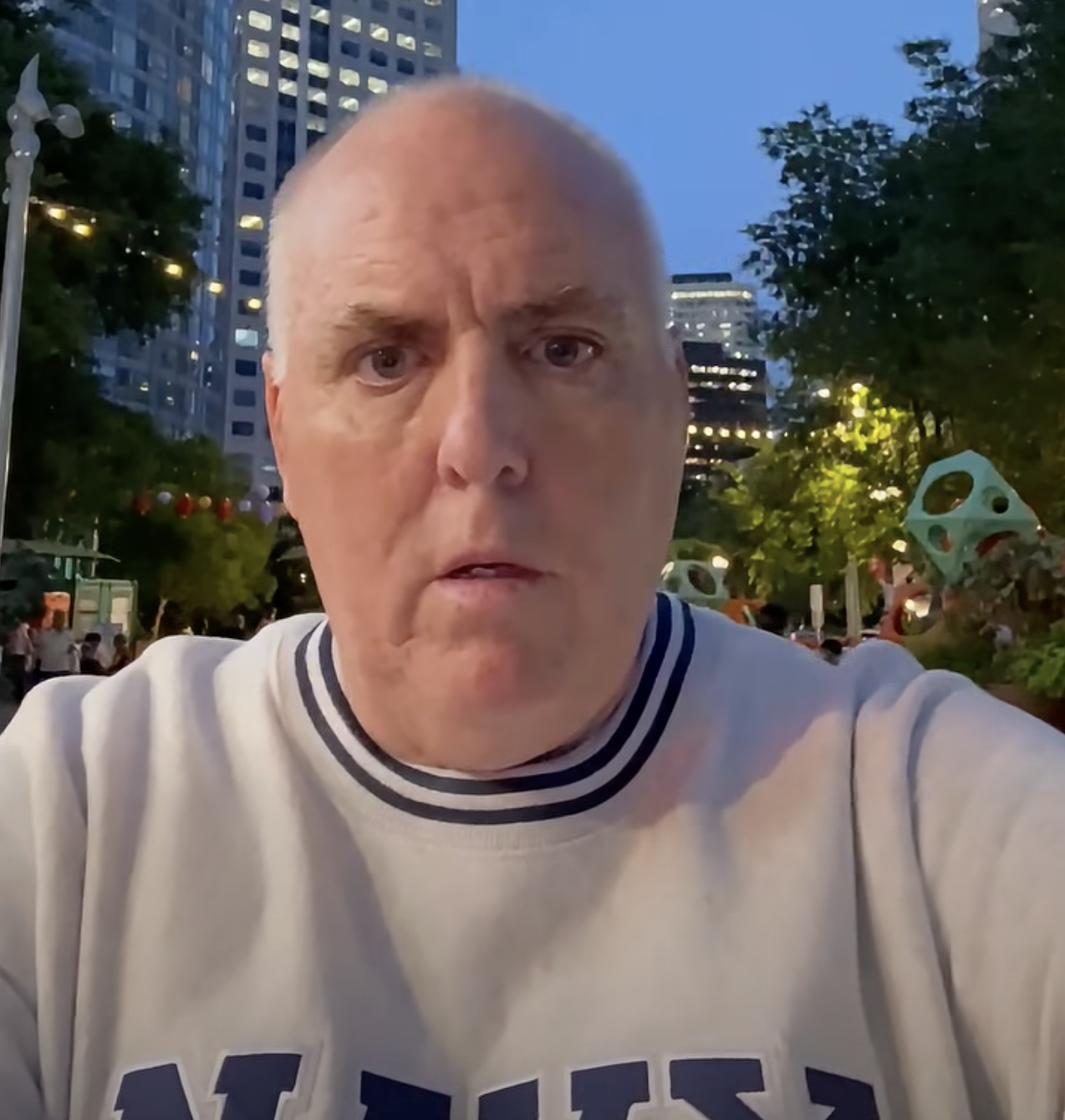
On Thursday, Ed Flynn called for a military occupation of Boston.
"I know it's somewhat controversial, but I do believe the National Guard could play a critical role in supporting, in a supportive role with Boston police," he said. His reasoning was staffing: "Simply because we don't have enough police officers, Boston acknowledges this, and it's creating neighborhoods that are not safe."
Here is what he was responding to. An incident occurred near North Station where a man stabbed a woman multiple times in a hallway behind a Dunkin' and then stabbed himself. "It is apparent to us that the two of them were involved in a domestic relationship, and we believe this incident to be domestic-related," Superintendent Paul McLaughlin said at the scene. The woman is thankfully expected to survive. The man's wounds are life threatening and self-inflicted. The night before, a man was tragically killed on an escalator inside South Station after a fight with a friend. Both had traveled from Memphis to raise money for a youth basketball program back home. Police called it targeted rather than random, and the man who killed him fled the station and has still not been caught.
An intimate partner assault that ended in an attempted suicide. A fight between two friends over a $25 phone bill. There is no configuration of armed personnel on Causeway Street that prevents either one.
Flynn knows this. He proposed a military solution anyway, because the army and the police are the only two things he ever proposes.
By the end of Friday, Flynn had retreated. Mayor Wu's reaction to his proposal was that it was "frankly foolish and irresponsible," saying the specific causes are the only route to solutions. The councilor from South Boston shriveled up. By that afternoon the Guard was no longer going to play a critical role. It was, "is there a role for the National Guard to play? Or is there not a role for them to play? It's worth having the conversation." Then the police union broke with him, telling reporters the department is understaffed but nowhere near the level that warrants calling in the Guard. Even Nick Collins, his closest ally, told CBS he believed the stabbing was an isolated incident and that the transit system is safe. Twenty four hours took Flynn from a demand, to a question, to running away from the idea overall.
The pattern is the story, and it has been for years. Whatever the problem is, the answer is more uniforms. The city's own crime data through August 9 shows homicides down 17 percent from last year, reported rapes down 22 percent, and shooting incidents running nearly a quarter below the five-year average. What has risen is aggravated assault, which is the offense category that patrol presence is least able to touch because it happens between people who already know each other, and in South Boston a jump in shoplifting and auto theft that accounts for nearly the entire increase in that district's crime total. Robbery and assault in Flynn's district both sit below their own five-year averages.
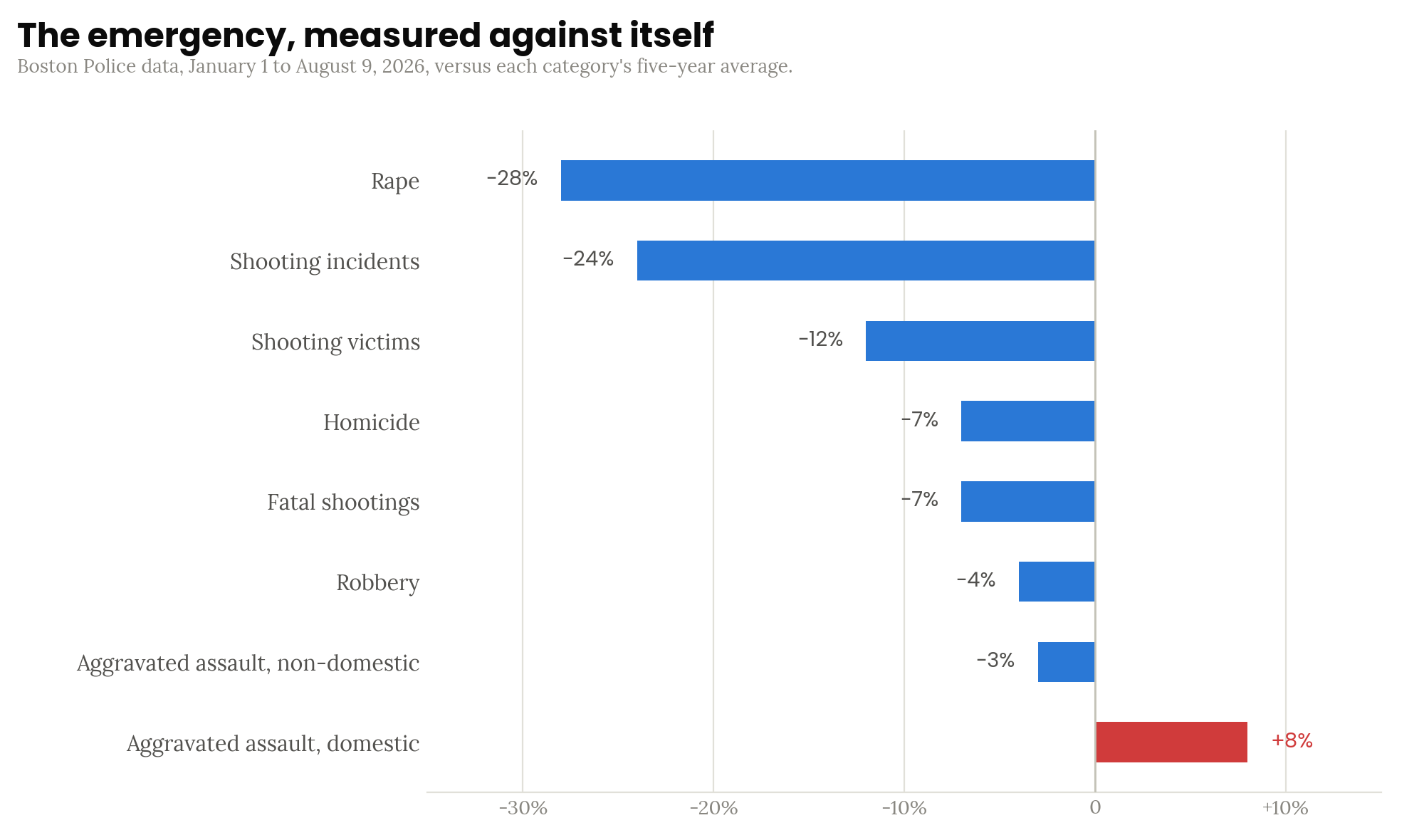
So the honest summary is this: the violence Flynn invoked is falling. The categories that are climbing are either invisible to deterrence or are retail theft. He proposed a military deployment to address shoplifting.
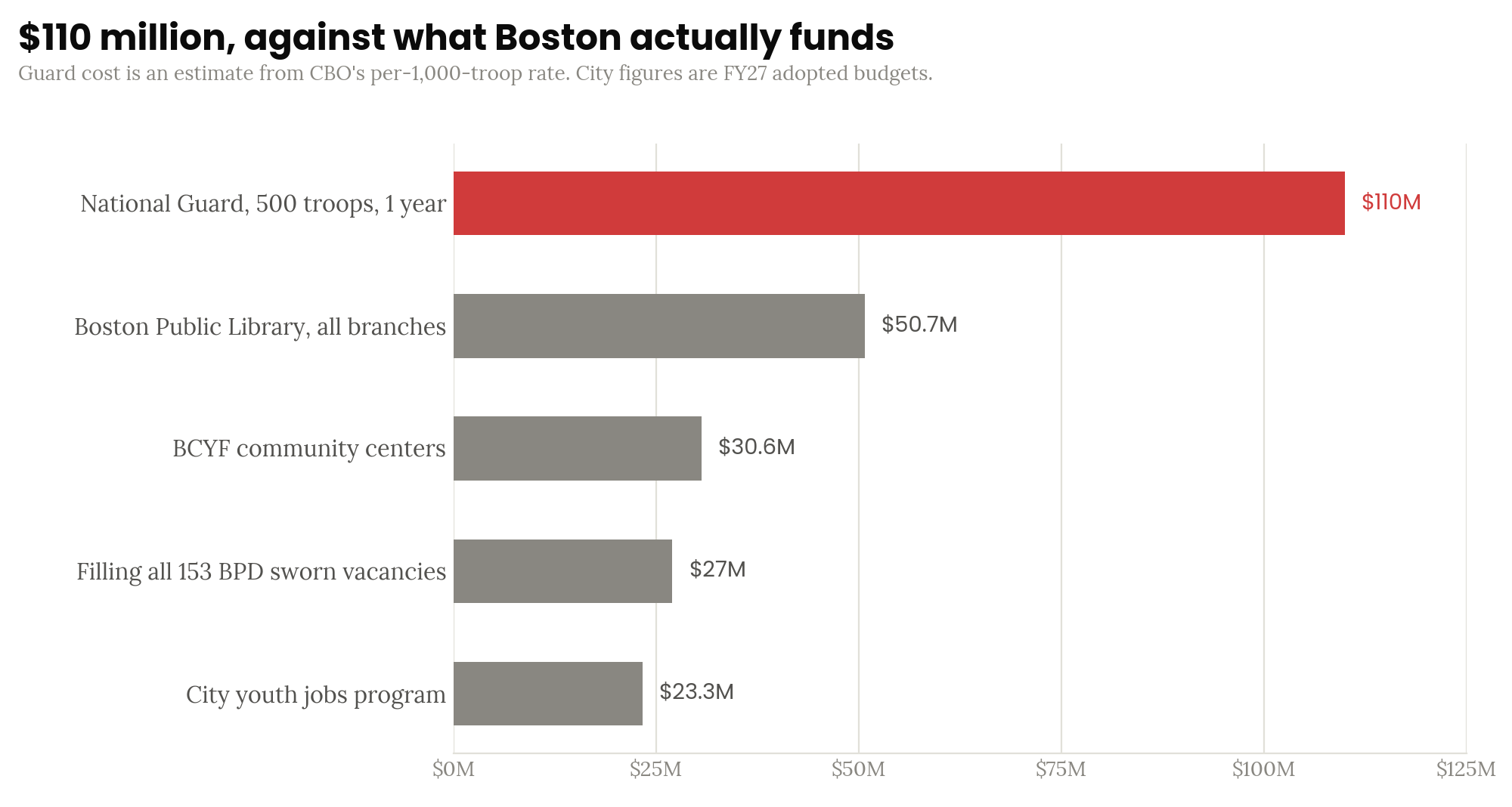
The bill for that is not theoretical. The Congressional Budget Office estimates that each additional 1,000 Guard personnel deployed to a city in 2026 costs between $18 million and $21 million a month. Five hundred soldiers in Boston runs somewhere near $110 million a year. And Flynn asked for the Massachusetts Guard, which means state active duty, activated by the Governor. States directly fund state active duty orders. Massachusetts residents pay every dollar. The only alternative route is federalization under Title 10, where President Trump would take command and Washington would pay, which trades the money for control of our streets. Is that what you really want?
Washington has already run the experiment. The deployment there cost $332 million through February, roughly $1.65 million a day. Per a U.S. Senate Committee report, it is on pace to pass $600 million at the one-year mark, more than the entire annual budget of the D.C. police department. The Pentagon now projects another $1.43 billion to keep troops in place through January 2029. What that purchased, according to the Niskanen Center, was a 24 percent reduction in property crimes such as theft and vehicle break-ins, and no discernible decrease in violent crime. Their phrase for it: "an expensive tool deployed in the wrong places for the wrong types of crime." Six months in, Guard leadership could not name a single measurable public safety outcome attributable to their presence.
None of this should surprise anyone who has looked at the research, because the premise underneath Flynn's request has been failing tests since 1974. That year, the Kansas City Preventive Patrol Experiment cut patrol to zero in five police beats, doubled or tripled it in five others, and left five alone. There was no significant difference in crime, in residents' fear of crime, or in their satisfaction with police. The department's own conclusion was that routine patrol in marked cars has little value in preventing crime or in making people feel safe, and that those resources could safely be spent elsewhere.
And Flynn, who insists Boston cannot afford its own programs, wanted to spend $110 million a year on it.
Remember that he was the single vote against Wu's property tax fix. The Council passed it 12 to 1, with Flynn casting the sole no. His stated reason: "We just can't continue spending money non-stop on every single program...We have to be fiscally responsible and fiscally disciplined." Nick Collins (who left him high and dry on the Guard matter) then blocked the measure from reaching a Senate vote and Bostonians got the bill. As a result, the average homeowner's tax bill went up 13 percent, or $780. Bostonians are paying more right now because of the position Flynn took and the senator he stood beside. Yet, he wanted you to dig deeper for his burning desire to see men with rifles on your street.
This is not fiscal discipline. This is a man who calls every expense reckless except the one he likes, and who reaches for the most expensive instrument in American government whenever a camera is pointed at him.
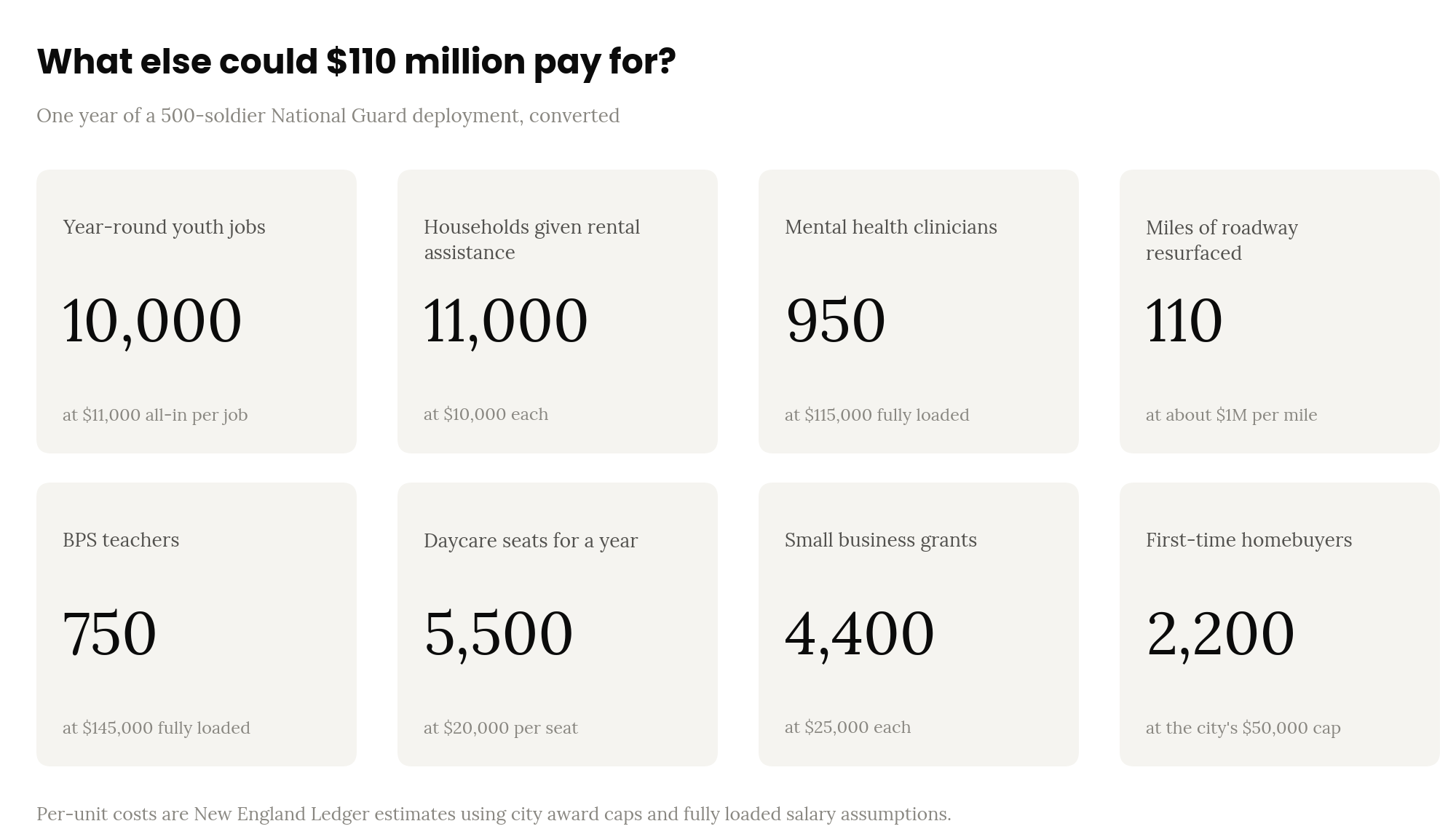
There is a real conversation to be had, and it starts with what safety actually means. Safety is being able to walk, work, and live across this city without fear of molestation. It is not people in helmets on every corner. The money in question could fund the mental health response that Thursday's call on Causeway Street genuinely required. It could fund summer employment for young people, which is among the most promising and cost-effective violence prevention interventions cities have. It could fund the unglamorous physical work that keeps showing up in the research: studies in Youngstown and Flint found that maintaining vacant lots cut violent crime sharply, and researchers confirmed the crime did not simply move next door.
We have local examples that prove this too.
Ray Flynn–Ed's father, a fact he will never let you forget–became mayor in 1984 and governed through the worst violence in the modern history of Boston. The crack epidemic nearly doubled Boston's homicide rate between 1987 and 1990, ending in a record 152 killings in 1990. Juvenile handgun homicide victims tripled over the same three years, from 22 to 73. Not two stabbings in a week. One hundred and fifty two bodies in a single year.
Flynn the Elder did not call for the National Guard. His administration's approach was neighborhood-focused and proactive rather than purely reactive, and when the violence moved into the streets, his method was to engage, making house calls to the families being victimized. He went to the door. Whatever else he got wrong, he understood that the work was person to person, in the neighborhood, done by people who lived there.
His son had two stabbings, one of them a domestic assault, and went to every pen and microphone he could find to demand armed troops.
For Ed Flynn, this is not a case of the apple falling far from the tree, but rather a whirlwind picking up the apple and carrying it two continents away. A future Ledger investigation will look further into Flynn's follies. For now, it should be clear that there is a reason we call him "Five-Alarm Flynn:" he is pulling fire alarms over cigarette smoke and sticking taxpayers with the bill.