Red, White, & Sometimes Blue (Pt. 2)
Nick Collins told WBUR most of his contributions came from Boston residents. His own filings have never shown a majority, on any measure, in any period.
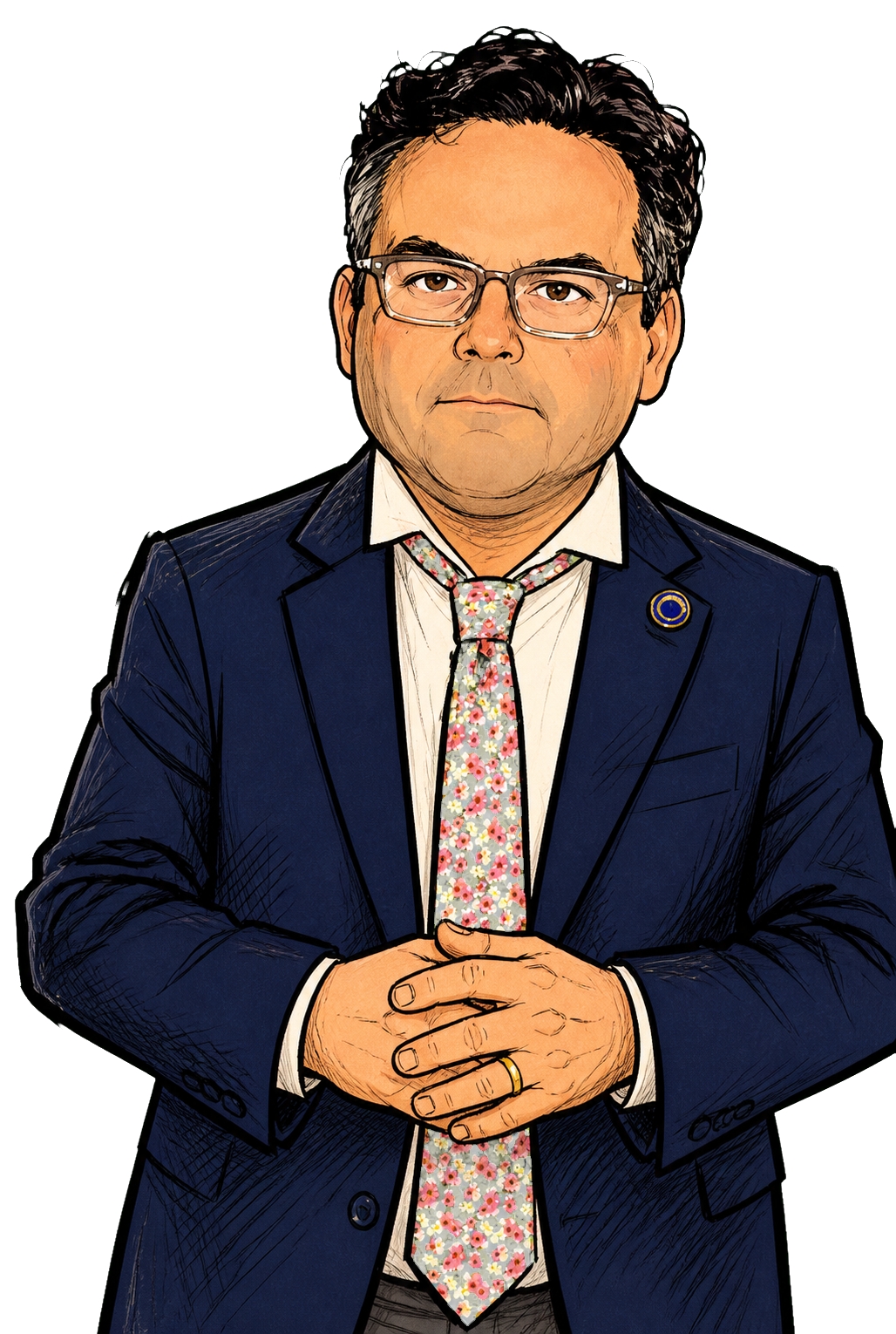
Nick Collins sells one thing better than almost anything else: proximity. He is the neighborhood senator, South Boston born and raised, host of the St. Patrick's Day breakfast, a fixture in union halls, neighborhood meetings and parades. His campaign's argument is that he understands the district because he came out of it.
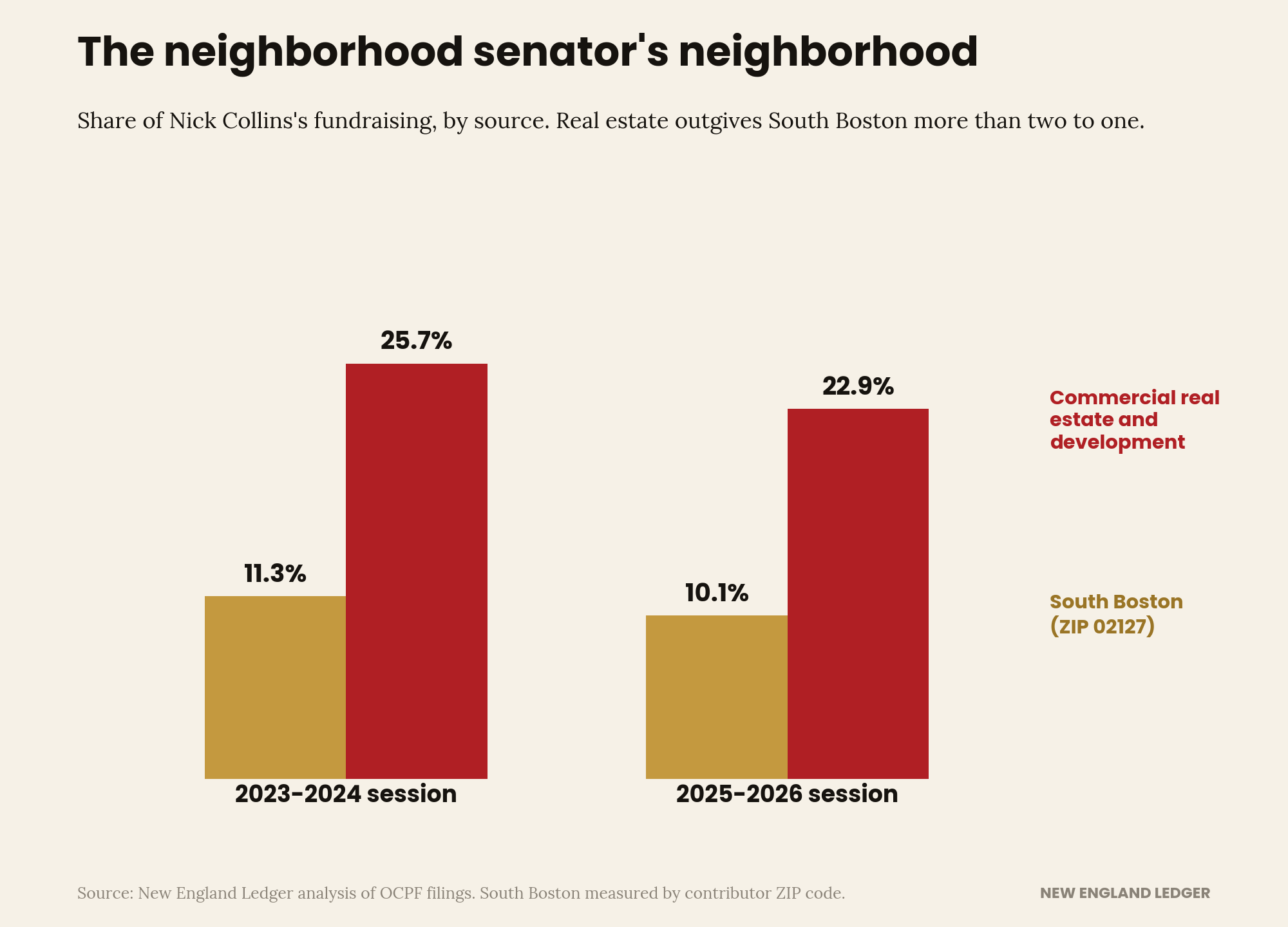
But the money keeping him there increasingly comes from somewhere else. A New England Ledger analysis of 1,909 contributions reported to OCPF between January 2024 and Aug. 5, 2026 found that roughly 59 percent of the dollars Collins raised came from contributors listing addresses outside Boston. That figure understates the distance. The First Suffolk sits entirely within the city, so every dollar from Quincy, Newton, Brookline, Winchester, Milton or Hingham is out-of-district by definition, and plenty of the Boston dollars are too. Quincy contributors gave more than $22,000 during the period examined, Brookline more than $15,000, Newton more than $14,000, Winchester and Milton more than $13,000 each, Hingham nearly $13,000.

So how much does a neighborhood senator cost?
Commercial real estate provides part of the answer. WBUR exposed the first wave in 2024, reporting that Collins took $17,250 from real-estate-related interests in October and another $17,200 in November while he was stopping Mayor Michelle Wu's property-tax proposal. Roughly sixty percent of everything he raised that November came from the industry. Collins responded that a majority of his contributions came from Boston residents. The Ledger's analysis of six years of his filings shows that Boston has never been a majority of his contributions, on any measure, in any period.
Insert Maury Povich meme.
What happened after that story left the headlines is the part nobody has told. The checks kept coming.
On April 22, 2026, four BXP employees and executives gave Collins $2,700 in a single day, among them chairman and chief executive Owen Thomas and executive Doug Linde. BXP is one of the region's commercial-real-estate giants, with a Boston portfolio spanning 16.5 million square feet across 52 properties, including the Prudential Center, 200 Clarendon, 100 Federal Street and Atlantic Wharf. Two weeks later came a more concentrated haul: on May 6, Collins raised $4,950, and six contributors from Oxford Properties and Pappas Properties supplied $4,200 of it, nearly 85 cents of every dollar that day. Oxford entered Boston by acquiring 2.7 million square feet of office space and says it became the city's second-largest landlord within two years. Then on June 3, Collins raised $3,000, of which three employees of WS Asset Management gave $2,250, or 75 percent of the day's total. WS Development controls 33 acres and 7.6 million square feet in the Seaport and calls it the largest active development project in Boston's history.
The Ledger's review also found money from people tied to the Davis Companies, Corcoran Jennison, Synergy, HYM Investment Group, TCR Development, Lincoln Property Company and other firms embedded in Boston's development economy.
As Part 1 laid out, these donors knew exactly where Collins stood. Falling commercial valuations meant homeowners were about to absorb more of Boston's existing tax burden while commercial owners received reductions. Wu wanted to slow that transfer. Collins stopped her, and Boston homeowners ultimately faced an average 13 percent increase.
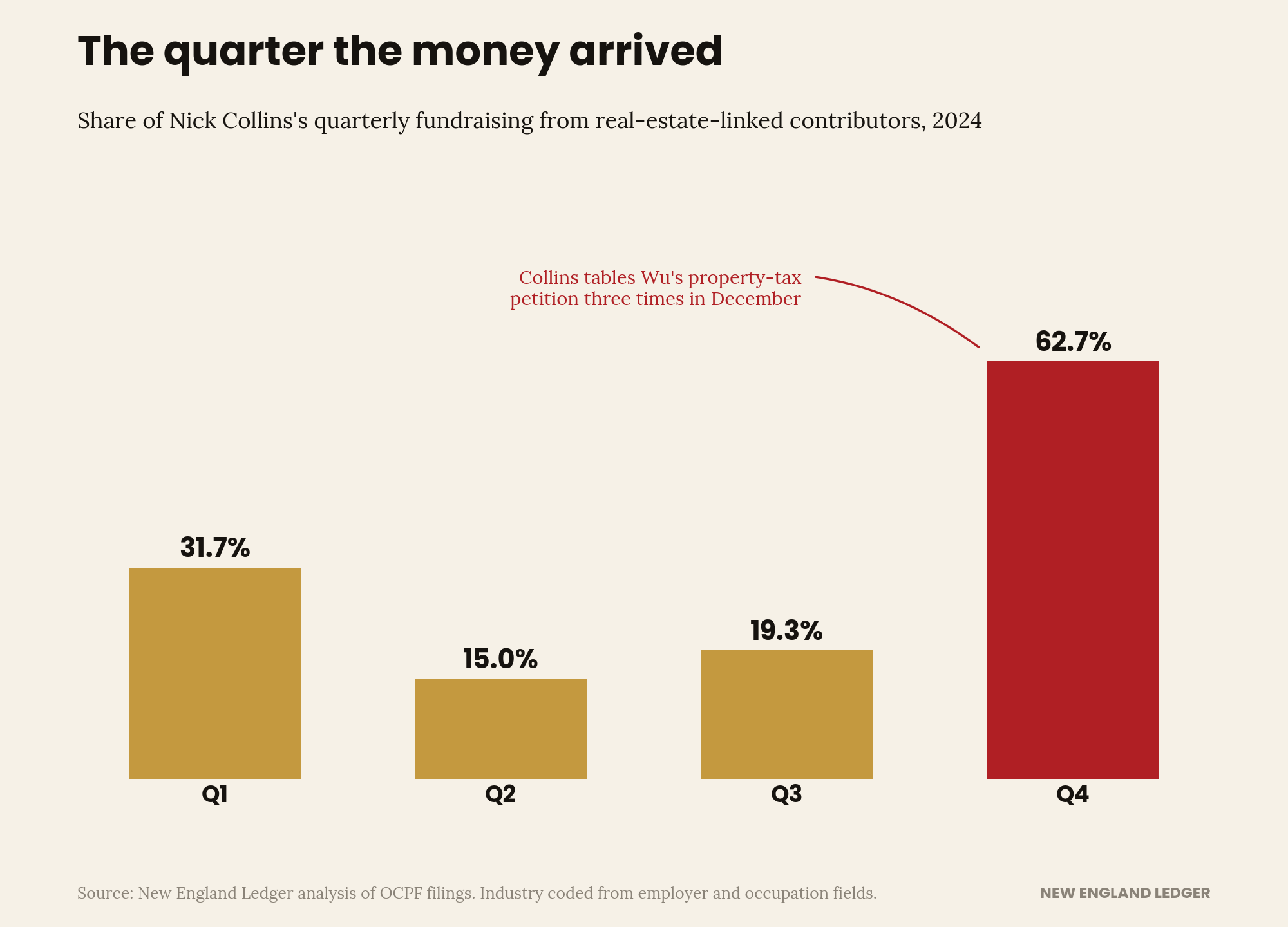
The timing tells the story better than any single donor does. In 2023, before the fight, real-estate-linked money accounted for 15.7 percent of Collins's fundraising. In the fourth quarter of 2024, the quarter he was blocking the mayor's petition, it accounted for 65.5 percent. The three quarters before it ran between 15 and 32 percent. Then the industry's share fell back toward its baseline, and the money kept arriving anyway.
And now it is showing up on lawns. OCPF records show the campaign spent $3,449.94 on signs in July 2026 alone through Connolly Printing, a family-run union shop founded in 1969, and $38,847.24 on mailings through the same company in the same month.
Consider what that means on an ordinary Boston street. A homeowner opens a tax bill that is higher because more of the city's levy shifted onto residential property. Outside, staked in the grass, a Nick Collins sign asks that homeowner to reelect the senator who fought the proposal designed to hold the increase down. The treasury that paid for the sign was filled, in part, by executives whose companies own some of Boston's largest commercial portfolios and had a direct financial interest in preserving their own decrease.
The buildings got the decrease. The homeowners got the lawn signs.
The mailers work the same way. Tens of thousands of dollars of Collins literature is landing in the hands of residents carrying larger tax bills, financed by a donor base that includes the industry that fought to keep the burden off its own buildings. That is what campaign money buys: repetition, visibility, field staff, glossy mail, and the power to tell voters who is supposedly fighting for them.
Collins calls himself the neighborhood senator. His filings describe a political operation financed by people who do not live in the neighborhood, do not vote in the district, and did not need to. When WBUR questioned his real-estate money in 2024, Collins said a majority of his contributions came from Boston residents, including organized labor. Over the nearly three years the Ledger examined, only about four in ten dollars came from contributors listing Boston addresses. The rest came from somewhere else.
Which leaves the First Suffolk with a question that gets harder to avoid each time another Collins sign appears beside another higher tax bill.
Who does Nick Collins really work for?
"Red, White & Sometimes Blue" examines New England Democratic politicians whose governing records reveal a more complicated ideology than their party label suggests: lawmakers who campaign on Democratic values but often side with Republicans, business interests, or traditional power structures on issues affecting their working-class constituents.