Disgraced Former Democratic State Senator and Boston NAACP Appeal to Trump Administration to Withdraw Funds
Dianne Wilkerson and Reggie Stewart want federal officials to withdraw $80 million from the Blue Hill Avenue redesign as the Trump administration targets transportation projects tied to equity and climate policy.
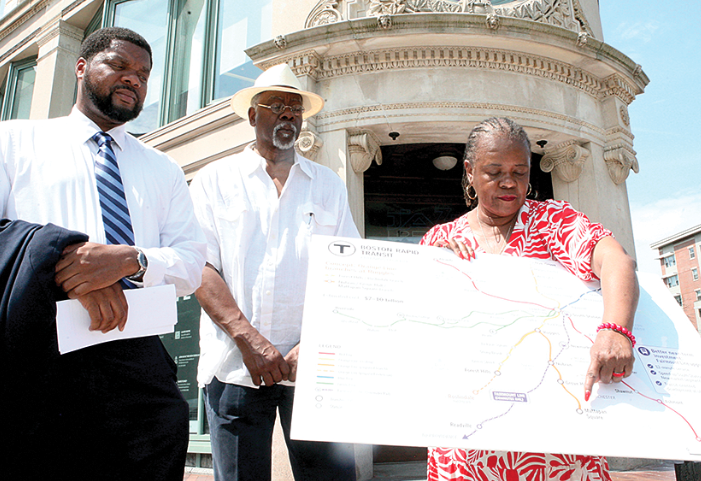
Former Massachusetts state Sen. Dianne Wilkerson, whose political career ended after she admitted to accepting $23,500 in bribes, is once again attempting to influence how millions in public funding are spent—or not spent—in Boston’s Black neighborhoods.
This time, she is appealing directly to the Trump administration.
Wilkerson, Boston NAACP Environmental and Climate Justice Committee Chair Reggie Stewart, and Garrison Trotter Neighborhood Association (GTNA) President Louis Elisa recently asked Transportation Secretary Sean Duffy to withdraw approximately $80 million from Boston’s proposed Blue Hill Avenue redesign. The federal funding represents nearly half of the estimated $162 million project, which would reconstruct roughly three miles of Blue Hill Avenue with new sidewalks, crossings, lighting, trees, bicycle infrastructure and, controversially, center-running bus lanes. The lanes are intended to improve service for approximately 37,000 daily riders. City officials estimate they could shorten some rush-hour trips by 10 to 15 minutes.
The letter was accompanied by a petition organizers say was signed by 2,600 residents. The US Department of Transportation confirmed that it received the request and is reviewing it, according to the Dorchester Reporter.
"Understand the extraordinary moment we are in right now when a predominantly Black community throws up their arms after not being heard for five years and comes together and decides to appeal to the Trump Administration for protection," Wilkerson said at a June press conference.
Wilkerson and her allies want officials to reconsider the bus-lane proposal and revive discussions about restoring rail service toward Mattapan.
Withdrawing the grant, however, would not redirect that money to an Orange Line extension. No federal commitment, approved route, design or construction schedule currently exists for the rail proposal.
Appealing to an administration cutting similar projects
The request comes as the Trump administration moves against transportation and other investments associated with racial equity, environmental policy and reduced dependence on automobiles.
Duffy has criticized what the administration calls “DEI bike lanes,” frozen or canceled bicycle and pedestrian grants, and encouraged restrictions on future bicycle infrastructure.
In Fairfield, Alabama—a predominantly Black city where 17 percent of households lack access to a car—the administration canceled an $11.7 million grant for a walking and bicycle path. It has also frozen funding elsewhere and attempted to remove an existing bicycle lane near the White House.
Stewart acknowledged the conflict in an interview quoted by the New York Times and republished by Boston.com.
"Ironically, in my climate and environmental justice work, we’re opposing a lot of what Trump is for,” Stewart said. “But in this case, he might be an ally."
A further irony noted by some community members is that the chair of Environmental and Climate Justice would oppose funding for a project meant to address the issues said committee is believed to be focused on. Proponents for the project note studies showing the harmful effects of a large number of vehicles traveling through an area can have on the health of a population. Further evidence in other studies have shown that it can take a bus up to an hour to travel from Mattapan Square to Nubian Square, sitting for minutes at traffic lights emitting fumes into the neighborhood. It is unclear to the New England Ledger if this is permissible to the Boston NAACP.
At the same time, opponents have raised legitimate concerns about parking losses, congestion, construction disruption and whether the city adequately incorporated community feedback. They also have pressed the City for years on addressing the concerns of small business owners who will most assuredly lose customers and revenue both during construction and following completion. Construction of the corridor would simultaneously take place with the use of a renovated White Stadium. At the writing of this, there is no public plan for addressing the convergence of these projects and mitigating the effects on residents, business owners, and other stakeholders.
Alternative for Community and Environment (ACE), a Roxbury-based organization with decades of environmental-justice and transit advocacy experience, supports moving the redesign forward while calling for stronger community oversight and protections.
Supporters also note that approximately 80 percent of the project budget would fund pedestrian-safety and streetscape improvements rather than the center-running lanes themselves.
From City Hall to Trump's White House
Wilkerson, the GTNA, and leaders of the Boston NAACP have increasingly emerged as a recurring opposition bloc to Mayor Michelle Wu on major projects affecting Black Boston. The most sustained example has been White Stadium, where they have challenged the administration’s planning, costs, transportation strategy and community-engagement process, supported efforts to stop or substantially alter the project, and accused Wu of ignoring Black residents. The legal campaign suffered its most significant defeat on Aug. 19, when the Massachusetts Supreme Judicial Court rejected the challenge to the redevelopment and cleared construction to continue.
The disputes themselves are not frivolous. White Stadium’s escalating cost, traffic implications and public-private structure have generated legitimate questions, just as the Blue Hill Avenue redesign has raised concerns about parking, businesses and whether years of public meetings amounted to meaningful public consent.
Blue Hill Avenue represents an escalation in tactics. After failing to stop White Stadium, the group has carried their latest fight to the doorstep of a president whose administration has spent months dismantling many of the transportation, environmental and racial-equity policies these same organizations have traditionally defended.
Of concern to the community is that if they successfully halt the projects, there is no binding guarantee that stopping them would produce any actionable alternatives. In effect, Black Boston could lose two major committed investments without either being replaced, leaving the community with fewer dollars and infrastructure needs that could remain unresolved for years.
A recurring District 7 corruption story
Wilkerson’s renewed attempt to shape public investment carries echoes of a troubling chapter in Roxbury politics.
The first Black woman elected to the Massachusetts Senate, Wilkerson resigned in 2008 and later pleaded guilty to eight counts of attempted extortion. Federal prosecutors said she accepted eight cash payments totaling $23,500 in connection with her official duties.
That investigation also reached then-District 7 City Councilor Chuck Turner.
According to the US Attorney’s Office, Wilkerson asked Turner to help Roxbury businessman Ronald Wilburn obtain a liquor license. Wilburn, who was secretly cooperating with the FBI, later paid Turner $1,000 while discussing the license. Turner was convicted of accepting the payment and lying to investigators. He was sentenced to three years in prison.
Nearly 15 years later, District 7 was again consumed by a public-corruption case.
Former Councilor Tania Fernandes Anderson pleaded guilty to taking a $7,000 kickback from a staff member’s city-funded bonus. Prosecutors said the money was exchanged inside a City Hall bathroom. She was sentenced to one month in prison, three years of supervised release and $13,000 in restitution.
Wilkerson was not a distant observer during Fernandes Anderson’s tenure. She sat on the councilor’s District 7 Advisory Council, which Fernandes Anderson consulted about her resignation timeline and transition plans.
Even after Fernandes Anderson agreed to plead guilty, Wilkerson publicly defended her and warned candidates seeking the seat against campaigning on a promise to “restore honesty and integrity.”
“Don’t tell me you’re running because you want people to forget Tania,” Wilkerson told candidates at an April 2025 forum, according to the Boston Herald.
Wilkerson also appeared to question the federal case, saying candidates could not condemn how authorities “come in our community, destroy people” while embracing what she called “the story and the lies.”
Stewart had an even more direct institutional connection. He served as director of community relations in the District 7 office during Fernandes Anderson’s tenure, acting as a liaison between the council office and residents.
Now Wilkerson and Stewart are together asking another federal administration to intervene in Black Boston—this time by withdrawing $80 million from one of the community’s largest proposed transportation investments.
Wilkerson’s unfinished reckoning
Wilkerson has said she apologized for her own conduct, but her subsequent statements have stopped short of an unequivocal acceptance of wrongdoing.
“If what I did was wrong,” she told Boston Magazine in 2022, “it was a stretch.”
Wilkerson’s conviction does not disqualify her from participating in public debate. But her history—and her continued defense of another District 7 official convicted of misusing public money—makes her renewed attempt to influence $80 million in federal funding part of the Blue Hill Avenue story.
If Duffy grants the group’s request, Boston could lose the funding without any requirement that the Trump administration replace it or invest the money elsewhere in the community.
It begs the question for the reader: if Wilkerson and the Boston NAACP are successful in their request to the Trump administration to take back a Biden-era grant, and if there is little support and, likely, no chance that additional federal funds will be approved for an extension of subway service, what is their plan for improving and modernizing a large stretch of roadway that has been underdeveloped for decades?